
Building a future-ready culture: Practical insights to unlock performance and drive growth
September 2026 | London Wall, London
Building a future-ready culture: Practical insights to unlock performance and drive growth
September 2026 | London Wall, London





SPONSORS



Culture has moved from being a supportive backdrop to a critical determinant of organisational performance, growth and resilience. Boards and executive teams now expect culture to do real work: enabling strategy delivery, accelerating decision making, shaping leadership behaviour and helping organisations adapt at speed in a fast changing, high pressure environment. When culture and strategy are misaligned, progress stalls. When they are aligned, organisations move faster, attract stronger talent and outperform their peers.
Against a backdrop of sustained economic pressure, rapid AI adoption, evolving workforce expectations and growing complexity, HR and people leaders are being asked to translate culture into a tangible, investible business asset - not a set of values statements or engagement activities. At the same time, they are grappling with declining engagement scores, increasing manager load, hybrid tensions and the need to balance human judgement with data driven decision making.
What to expect on the day
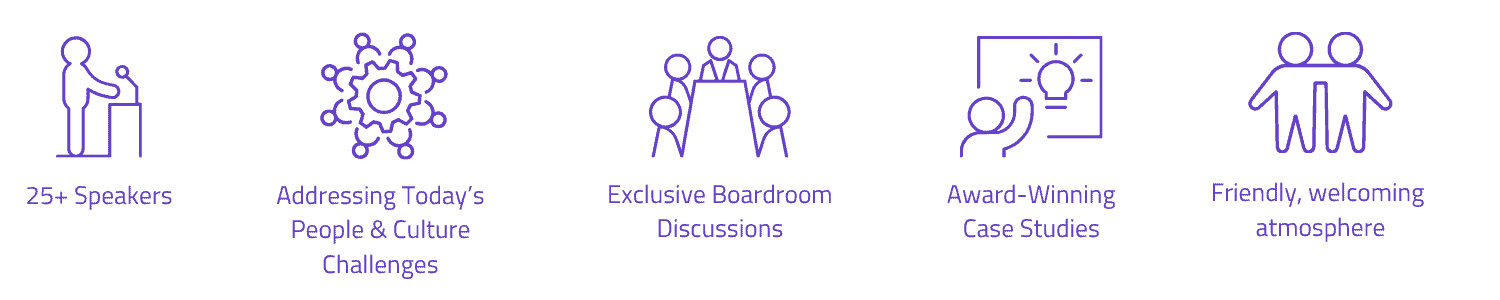
This full day, insight packed conference bringing together CPOs, HRDs and people, culture and transformation leaders to explore how high performing organisations are responding to these challenges in practice.
What to expect on the day
This full day, insight packed conference bringing together CPOs, HRDs and people, culture and transformation leaders to explore how high performing organisations are responding to these challenges in practice.
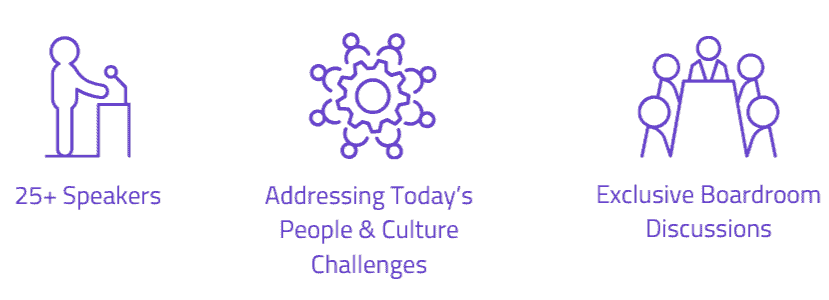
Through a mix of keynote perspectives, practitioner led case studies, candid panel discussions and invite-only boardroom conversations, speakers, including Business Culture Award winners and senior industry experts, will share how they are:

Redesigning leadership and operating models

Embedding culture as a growth and risk lever

Using people data more intelligently

Navigating AI, hybrid work and constant change

Building organisations that are both human centred and commercially focused
This is a practical, senior level forum designed to move beyond theory and surface the real decisions, trade-offs and tensions leaders are facing - and how they are addressing them.
Keynote Speaker: HR 3.0 Pioneer and Globally Recognised Organisational Futurist, Perry Timms

Session Title & Outline: “Culture in Motion: Building Polymorphic Organisations for a World That Won’t Stand Still"
As markets shift faster, technologies accelerate, and workforce expectations evolve in real time, many organisations are discovering that culture can no longer be treated as a static set of values, behaviours, or engagement initiatives. The organisations that will thrive in the coming decade are those able to adapt shape, rhythm, capability, and collaboration dynamically - without losing coherence, trust, or humanity.
About the Speaker: Perry Timms is an internationally recognised workplace futurist, organisational theorist, and founder of PTHR, one of the world’s leading self-managed consultancies. A 3x author, TEDx speaker, LinkedIn Learning instructor, and Visiting Fellow at multiple business schools, Perry’s work explores the future of organisations, culture, leadership, and human systems.
His work on HR 3.0, Organisational Oscillation, and Polymorphic Organisations is helping leaders rethink how enterprises can become more adaptive, human-centred, and future-ready in conditions of constant complexity and change. In 2024, PTHR was recognised among the world’s Top 50 self-managed organisations by the Haier Z Institute, and Perry received a Lifetime Achievement Award from WorldBlu for his contribution to progressive workplace thinking.
Keynote Speaker: HR 3.0 Pioneer and Globally Recognised Organisational Futurist, Perry Timms
Session Title & Outline: “Culture in Motion: Building Polymorphic Organisations for a World That Won’t Stand Still"
As markets shift faster, technologies accelerate, and workforce expectations evolve in real time, many organisations are discovering that culture can no longer be treated as a static set of values, behaviours, or engagement initiatives. The organisations that will thrive in the coming decade are those able to adapt shape, rhythm, capability, and collaboration dynamically — without losing coherence, trust, or humanity.
About the Speaker: Perry Timms is an internationally recognised workplace futurist, organisational theorist, and founder of PTHR, one of the world’s leading self-managed consultancies. A 3x author, TEDx speaker, LinkedIn Learning instructor, and Visiting Fellow at multiple business schools, Perry’s work explores the future of organisations, culture, leadership, and human systems.
His work on HR 3.0, Organisational Oscillation, and Polymorphic Organisations is helping leaders rethink how enterprises can become more adaptive, human-centred, and future-ready in conditions of constant complexity and change. In 2024, PTHR was recognised among the world’s Top 50 self-managed organisations by the Haier Z Institute, and Perry received a Lifetime Achievement Award from WorldBlu for his contribution to progressive workplace thinking.
View Business Culture Connected Speakers





 (opens in a new tab)
Aggie Cooke
People & Organisation Portfolio Integration Lead (Mars Snacking & Kellanova)
Mars



 (opens in a new tab)
Paul Morris
Internal Communications, Culture & Engagement Director Standard Life


 (opens in a new tab)
Matt Partovi
Head of AI Enablement & Skills, AI Transformation LeadFinancial Times








 (opens in a new tab)
Janette Lucas
Partner and Head of London Labour & Employment Team Squire Patton Boggs




View Business Culture Connected Speakers
(opens in a new tab)Aggie Cooke
People & Organisation Portfolio Integration Lead (Mars Snacking & Kellanova)Mars
(opens in a new tab)Matt Partovi
Head of AI Enablement & Skills, AI Transformation LeadFinancial Times
Session Speakers
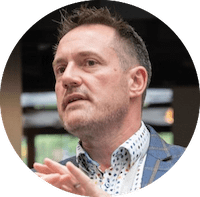 Bruce CharlesworthChief Medical Officer - Relief, Hygiene and Wellness, Reckitt Benckiser
 Bruce DaisleyEx-Twitter VP, now #1 Bestselling Author.
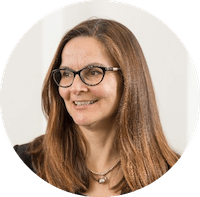 Helen KelleyInternal Communications & Engagement Director, Inmarsat
 Bjørn ThonvoldCorporate Vice President People & Organization, Xellia Pharmaceuticals
 Tali ShlomoHead of Inclusion and Wellbeing, Shearman & Sterling LLP
 Philip WilsonChief Psychologist & Chief Assessor, Civil Service Fast Stream
 Catherine DineleyHead of Group Culture, Lloyds Banking Group
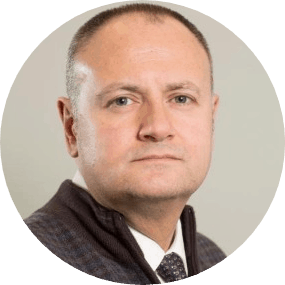 Eugenio PirriChief People and Culture Officer, Dorchester Collection
 Lena TailorEurope Head of People, innocent drinks
 Liz PannamanOrganisational Development Specialist, Transport for London
 Darryl CookeCo-Founder/Chief Executive, gunnercooke
 Lucinda PullingerGlobal Head of HR, The Instant Group
 Ali MohammedExecutive Director of HR & OD, South East Coast Ambulance Service NHS Foundation Trust
 Patti TurfreySenior Organisational Psychologist, Wrightington, Wigan & Leigh NHS Foundation Trust
 Steven CochranUK Culture Lead, Allied Irish Bank
 Katherine SaleDirector of Operations, Croud
 John ShurmerHead of Digital Learning, Barclays
 Helen RobertsBusiness Development & Marketing Manager, Go Engage / WWL NHS Foundation Trust
 Atif SheikhCEO, businessfourzero
 Sam SmithVice President & Managing Director, KellyOCG EMEA
 Natalie WhartonFounder & Managing Director, Wharton Business Consulting
 Paul O'NionsHead of Business Operations & Support, Sanofi UK
 Jenny PerkinsHead of Engagement, Cirrus
 Roxy EricksonDirector, Sunbeam Studios
 Alastair BarlowFounder & Chief Dreamer, flinder
 Fiona YoungContent Director and Director of Diversity & Inclusion, Hive Learning
 Jacqui WhyattSales & Architecture Group Lead, Kelly OCG EMEA
Conference Sessions
In a world of relentless disruption, transformation and competing priorities, many organisations are working harder than ever yet still struggling to accelerate growth and deliver their strategic ambitions. Often, the greatest obstacles are not external. They are the behaviours, decisions, ways of working and leadership habits that organisations have gradually learned to live with.
Please join us for this boardroom discussion led by expert facilitators Amanda Fajak and Jo Boxer, where we will explore a simple but provocative question: What are we tolerating today that is limiting our ability to grow, adapt and execute tomorrow?
Together, we will examine the role leaders play in setting standards, shaping ways of working and creating the conditions for sustainable performance in an increasingly complex and uncertain world.
As technology, markets, and workforce expectations evolve more rapidly and intensively than ever, organisations are being challenged to become more adaptive, responsive, and human - often all at once. In this keynote, Perry Timms explores the idea of the Polymorphic Organisation — organisations designed not around static structures, but around continuous evolution.
Rather than treating change as a one-off transformation programme, Perry shows how future-ready cultures are built incrementally through practical shifts in leadership, collaboration, skills, decision-making, and ways of working.
Blending systems thinking, organisational science, and real-world examples, this session offers a hopeful and grounded perspective on how organisations can begin building cultures fit for a world where flux has become the norm.
Across research from Gartner, i4cp and UK employers, one pattern is consistent: manager capability is the weakest link in most HR and transformation strategies. Change stalls, wellbeing suffers, hybrid working fractures and AI adoption falters – not because the strategy is wrong, but because managers are stretched beyond capacity and support.
In this session, Oliver Sturgeon will share how Pernod Ricard UK tackled this challenge head‑on by redesigning leadership development around the realities of the middle manager role. Faced with three very different businesses and a manager population disengaged from traditional programmes, Pernod Ricard launched INSPIRE – a coaching‑led, culture‑embedded approach with a bold ambition: to reach 100% of managers within 18 months.
Rather than treating development as a course to attend, INSPIRE positioned coaching as a way of leading, equipping managers to navigate complexity, build confidence and act as culture shapers. The result was visible behavioural and cultural change: stronger peer connection, senior advocacy and managers better equipped to lead through pressure rather than absorb it.
The session closes by addressing a critical question for HR and business leaders: are we asking the impossible of middle managers – or simply asking it in the wrong way?
In a world where disruption is constant, adaptability is becoming the ultimate competitive advantage.
Despite decades of investment in change management, organisations are experiencing greater change fatigue, lower resilience and increasing uncertainty. The challenge is no longer managing change. It is building an organisation that can thrive because of it.
In this provocative and practical keynote, Amanda Fajak explores why adaptability is emerging as the defining organisational capability of the next decade. Drawing on global research, leading organisations and real-world transformation experience, she reveals how culture, leadership and organisational design can either accelerate or constrain an organisation's ability to respond to change.
Participants will discover why traditional approaches are reaching their limits, what the world's most adaptable organisations do differently, and how leaders can build the resilience, learning agility and psychological safety needed to thrive in an environment of continuous disruption.
Key Takeaways
• Why adaptability is the new competitive advantage
• What is really driving change fatigue and organisational overload
• The cultural and leadership behaviours that accelerate adaptability
• How to build an organisation that learns, responds and evolves faster
Key Message
The winners of the next decade won't be the organisations with the best plan. They'll be the organisations that can change their plan fastest without losing their purpose.
As boards face increasing pressure to deliver growth, productivity and long-term value, they are asking tougher questions about investment in people, culture and employee experience. They want clearer evidence of impact, stronger links to business performance and greater confidence that culture is helping, rather than hindering, strategy execution. At the same time, many organisations are experiencing what some describe as culture atrophy: where values remain visible but no longer meaningfully shape decisions, behaviours or outcomes.
Please join us for this peer discussion facilitated by Phil Spratt, CEO & Founder of Deltabase, where we'll explore what it takes to engage boards in meaningful conversations about culture, performance and organisational effectiveness. We'll discuss how culture shows up in difficult business decisions, whether values truly survive under pressure, which culture metrics leaders trust most, and how to ensure culture remains a driver of delivery rather than becoming disconnected from business reality.
How do you know whether people, purpose and strategy are genuinely aligned and contributing to organisational success? In this session, Business Culture Certification co-creator Cath Longfield will briefly introduce the evidence-based Certification framework, developed in partnership with Hult International Business School to provide organisations with an independent way of benchmarking, recognising and celebrating cultures that are clearly contributing to organisational performance. Cath is joined by Sharon Lowrie and Laura Mwamba, CEO and Director of Business Development and Innovation, from certified organisation Be Caring, for a fireside conversation exploring how the organisation has aligned its purpose, people practices and business objectives to support sustainable growth, innovation and high-quality care in the social care sector. They will share their impressive culture journey, including lessons learned and reflections on the choices, investments and leadership behaviours that have helped create alignment across the organisation and a positive impact on the communities Be Caring serves.
Organisations are facing a paradox: the need for greater adaptability has never been higher, yet many employees and managers feel stretched by constant change, increasing complexity and competing priorities. So how do organisations continue building capability without adding to the burden? Our panellists have all faced the challenge of identifying and developing the capabilities their organisations need for long-term success in an environment of ongoing uncertainty. From learning, performance and recognition to leadership development, organisational resilience, and employee experience, they will share practical examples of what is working, and what we can all do differently, to sustain momentum and the long-term success of our organisations.
The Employment Rights Act 2025 represents the most significant overhaul of UK employment law in years. While awareness of the changes is high, many organisations are still grappling with what they will mean in practice, not only from a compliance perspective, but for leadership, management capability and workplace culture. For many HR leaders, the challenge is no longer understanding the legislation itself. It is helping managers navigate new expectations, ensuring HR is seen as an enabler rather than a blocker, and embedding changes in a way that strengthens rather than disrupts organisational culture.
Please join us for this peer discussion facilitated by Janette Lucas, Partner and Head of the London Labour & Employment Team at Squire Patton Boggs, where we'll explore the practical implications of the Act and the opportunities and challenges it presents for organisations. Together, we'll discuss which changes are already creating friction for managers, how organisations are preparing leaders for new responsibilities, whether the new rights will ultimately harden or humanise workplace culture, and how HR teams can balance compliance with positive employee experience.
Organisations have unprecedented access to people and culture data, yet many still struggle to turn insight into meaningful action. As employee listening becomes more sophisticated and AI opens up new possibilities for understanding workforce sentiment, leaders face a more important challenge: deciding what matters, prioritising where to act, and creating accountability for change. Research from more than 150 organisations for this recent whitepaper suggests that while data collection is increasing, many organisations still find it difficult to connect insight to business outcomes and sustained cultural improvement.
In this panel discussion, experts from research, financial services, inclusion and people leadership will explore how organisations can move beyond measuring culture to actively shaping it. Drawing on experience from organisations including Ipsos, Standard Life and Alzheimer's Society, and informed by Kerri O’Neill's recent work on rapid reculturing at pace and scale, panellists will discuss how to combine data, judgement and leadership action to create cultures that drive performance, engagement and long-term success.
What if doing good wasn’t separate from doing business, but fundamental to how the business works?
Recycling Lives Services proves it can be. They combine commercial materials processing with employment and rehabilitation, running prison workshops and employing people on Release on Temporary Licence (ROTL), creating routes back into work and cutting reoffending.
Their partnership with British Gas shows this in action. Waste from British Gas's meter replacement programme is processed through prison workshops, recovering materials for recycling and reuse. The gold from the circuit boards is even recovered and turned into jewellery with the Royal Mint.
Purpose that's good for people, planet, and business.
Most organisations say culture matters. The tougher question is whether it contributes meaningfully to growth, performance and competitive advantage. In this candid panel discussion, senior people leaders will explore where culture creates measurable business value and where it can become a barrier to progress. Drawing on experiences from financial services, technology, housing and other high-performance environments, panellists will discuss the link between culture, inclusion, leadership and organisational success, sharing practical examples of what they've seen work in practice. The conversation will also tackle one of the most challenging questions facing HR leaders today: if culture deserves investment, how do we demonstrate the return?
How do you build a future-ready culture while adopting AI responsibly? This session explores how the Financial Times is preparing its people and organisation for a changing world of work. It will share practical lessons from the FT’s approach to AI fluency, responsible and ethical AI, immersive learning and experimentation, alongside how its operating model is evolving to support adoption at scale.
ECL was at a pivotal point in its evolution. A new Business plan and People Strategy had set an ambitious direction for the future, but delivering them successfully in a challenging and rapidly changing social care environment would require far more than a new plan – it demanded a fundamental shift in culture, collaboration and collective leadership.
This session explores how ECL and ETS partnered to turn that ambition into reality. Jenni and Graham will share the challenges they faced, both before and during. They’ll also set out the evidence-based, co-designed approach they took to overcome them, and the lessons learned along the way. They will explore how strengthening leadership capability – both individually and collectively – created greater organisational alignment, laid the foundations for sustainable cultural transformation, and ultimately helped future-proof ECL for the challenges that lie ahead.
Conference Sessions
In a world of relentless disruption, transformation and competing priorities, many organisations are working harder than ever yet still struggling to accelerate growth and deliver their strategic ambitions. Often, the greatest obstacles are not external. They are the behaviours, decisions, ways of working and leadership habits that organisations have gradually learned to live with.
Please join us for this boardroom discussion led by expert facilitators Amanda Fajak and Jo Boxer, where we will explore a simple but provocative question: What are we tolerating today that is limiting our ability to grow, adapt and execute tomorrow?
Together, we will examine the role leaders play in setting standards, shaping ways of working and creating the conditions for sustainable performance in an increasingly complex and uncertain world.
As technology, markets, and workforce expectations evolve more rapidly and intensively than ever, organisations are being challenged to become more adaptive, responsive, and human - often all at once. In this keynote, Perry Timms explores the idea of the Polymorphic Organisation — organisations designed not around static structures, but around continuous evolution.
Rather than treating change as a one-off transformation programme, Perry shows how future-ready cultures are built incrementally through practical shifts in leadership, collaboration, skills, decision-making, and ways of working.
Blending systems thinking, organisational science, and real-world examples, this session offers a hopeful and grounded perspective on how organisations can begin building cultures fit for a world where flux has become the norm.
Across research from Gartner, i4cp and UK employers, one pattern is consistent: manager capability is the weakest link in most HR and transformation strategies. Change stalls, wellbeing suffers, hybrid working fractures and AI adoption falters – not because the strategy is wrong, but because managers are stretched beyond capacity and support.
In this session, Oliver Sturgeon will share how Pernod Ricard UK tackled this challenge head‑on by redesigning leadership development around the realities of the middle manager role. Faced with three very different businesses and a manager population disengaged from traditional programmes, Pernod Ricard launched INSPIRE – a coaching‑led, culture‑embedded approach with a bold ambition: to reach 100% of managers within 18 months.
Rather than treating development as a course to attend, INSPIRE positioned coaching as a way of leading, equipping managers to navigate complexity, build confidence and act as culture shapers. The result was visible behavioural and cultural change: stronger peer connection, senior advocacy and managers better equipped to lead through pressure rather than absorb it.
The session closes by addressing a critical question for HR and business leaders: are we asking the impossible of middle managers – or simply asking it in the wrong way?
In a world where disruption is constant, adaptability is becoming the ultimate competitive advantage.
Despite decades of investment in change management, organisations are experiencing greater change fatigue, lower resilience and increasing uncertainty. The challenge is no longer managing change. It is building an organisation that can thrive because of it.
In this provocative and practical keynote, Amanda Fajak explores why adaptability is emerging as the defining organisational capability of the next decade. Drawing on global research, leading organisations and real-world transformation experience, she reveals how culture, leadership and organisational design can either accelerate or constrain an organisation's ability to respond to change.
Participants will discover why traditional approaches are reaching their limits, what the world's most adaptable organisations do differently, and how leaders can build the resilience, learning agility and psychological safety needed to thrive in an environment of continuous disruption.
Key Takeaways
• Why adaptability is the new competitive advantage
• What is really driving change fatigue and organisational overload
• The cultural and leadership behaviours that accelerate adaptability
• How to build an organisation that learns, responds and evolves faster
Key Message
The winners of the next decade won't be the organisations with the best plan. They'll be the organisations that can change their plan fastest without losing their purpose.
As boards face increasing pressure to deliver growth, productivity and long-term value, they are asking tougher questions about investment in people, culture and employee experience. They want clearer evidence of impact, stronger links to business performance and greater confidence that culture is helping, rather than hindering, strategy execution. At the same time, many organisations are experiencing what some describe as culture atrophy: where values remain visible but no longer meaningfully shape decisions, behaviours or outcomes.
Please join us for this peer discussion facilitated by Phil Spratt, CEO & Founder of Deltabase, where we'll explore what it takes to engage boards in meaningful conversations about culture, performance and organisational effectiveness. We'll discuss how culture shows up in difficult business decisions, whether values truly survive under pressure, which culture metrics leaders trust most, and how to ensure culture remains a driver of delivery rather than becoming disconnected from business reality.
How do you know whether people, purpose and strategy are genuinely aligned and contributing to organisational success? In this session, Business Culture Certification co-creator Cath Longfield will briefly introduce the evidence-based Certification framework, developed in partnership with Hult International Business School to provide organisations with an independent way of benchmarking, recognising and celebrating cultures that are clearly contributing to organisational performance. Cath is joined by Sharon Lowrie and Laura Mwamba, CEO and Director of Business Development and Innovation, from certified organisation Be Caring, for a fireside conversation exploring how the organisation has aligned its purpose, people practices and business objectives to support sustainable growth, innovation and high-quality care in the social care sector. They will share their impressive culture journey, including lessons learned and reflections on the choices, investments and leadership behaviours that have helped create alignment across the organisation and a positive impact on the communities Be Caring serves.
Organisations are facing a paradox: the need for greater adaptability has never been higher, yet many employees and managers feel stretched by constant change, increasing complexity and competing priorities. So how do organisations continue building capability without adding to the burden? Our panellists have all faced the challenge of identifying and developing the capabilities their organisations need for long-term success in an environment of ongoing uncertainty. From learning, performance and recognition to leadership development, organisational resilience, and employee experience, they will share practical examples of what is working, and what we can all do differently, to sustain momentum and the long-term success of our organisations.
The Employment Rights Act 2025 represents the most significant overhaul of UK employment law in years. While awareness of the changes is high, many organisations are still grappling with what they will mean in practice, not only from a compliance perspective, but for leadership, management capability and workplace culture. For many HR leaders, the challenge is no longer understanding the legislation itself. It is helping managers navigate new expectations, ensuring HR is seen as an enabler rather than a blocker, and embedding changes in a way that strengthens rather than disrupts organisational culture.
Please join us for this peer discussion facilitated by Janette Lucas, Partner and Head of the London Labour & Employment Team at Squire Patton Boggs, where we'll explore the practical implications of the Act and the opportunities and challenges it presents for organisations. Together, we'll discuss which changes are already creating friction for managers, how organisations are preparing leaders for new responsibilities, whether the new rights will ultimately harden or humanise workplace culture, and how HR teams can balance compliance with positive employee experience.
Organisations have unprecedented access to people and culture data, yet many still struggle to turn insight into meaningful action. As employee listening becomes more sophisticated and AI opens up new possibilities for understanding workforce sentiment, leaders face a more important challenge: deciding what matters, prioritising where to act, and creating accountability for change. Research from more than 150 organisations for this recent whitepaper suggests that while data collection is increasing, many organisations still find it difficult to connect insight to business outcomes and sustained cultural improvement.
In this panel discussion, experts from research, financial services, inclusion and people leadership will explore how organisations can move beyond measuring culture to actively shaping it. Drawing on experience from organisations including Ipsos, Standard Life and Alzheimer's Society, and informed by Kerri O’Neill's recent work on rapid reculturing at pace and scale, panellists will discuss how to combine data, judgement and leadership action to create cultures that drive performance, engagement and long-term success.
What if doing good wasn’t separate from doing business, but fundamental to how the business works?
Recycling Lives Services proves it can be. They combine commercial materials processing with employment and rehabilitation, running prison workshops and employing people on Release on Temporary Licence (ROTL), creating routes back into work and cutting reoffending.
Their partnership with British Gas shows this in action. Waste from British Gas's meter replacement programme is processed through prison workshops, recovering materials for recycling and reuse. The gold from the circuit boards is even recovered and turned into jewellery with the Royal Mint.
Purpose that's good for people, planet, and business.
Most organisations say culture matters. The tougher question is whether it contributes meaningfully to growth, performance and competitive advantage. In this candid panel discussion, senior people leaders will explore where culture creates measurable business value and where it can become a barrier to progress. Drawing on experiences from financial services, technology, housing and other high-performance environments, panellists will discuss the link between culture, inclusion, leadership and organisational success, sharing practical examples of what they've seen work in practice. The conversation will also tackle one of the most challenging questions facing HR leaders today: if culture deserves investment, how do we demonstrate the return?
How do you build a future-ready culture while adopting AI responsibly? This session explores how the Financial Times is preparing its people and organisation for a changing world of work. It will share practical lessons from the FT’s approach to AI fluency, responsible and ethical AI, immersive learning and experimentation, alongside how its operating model is evolving to support adoption at scale.
ECL was at a pivotal point in its evolution. A new Business plan and People Strategy had set an ambitious direction for the future, but delivering them successfully in a challenging and rapidly changing social care environment would require far more than a new plan – it demanded a fundamental shift in culture, collaboration and collective leadership.
This session explores how ECL and ETS partnered to turn that ambition into reality. Jenni and Graham will share the challenges they faced, both before and during. They’ll also set out the evidence-based, co-designed approach they took to overcome them, and the lessons learned along the way. They will explore how strengthening leadership capability – both individually and collectively – created greater organisational alignment, laid the foundations for sustainable cultural transformation, and ultimately helped future-proof ECL for the challenges that lie ahead.
"What a triumph! It felt like one of the more useful, illuminating, and inspiring events in the calendar, so well done to you all!”
2022 HR Most Influential Thinker & 2x Author
"What a brilliant event - thank you all! I have so many notes, ideas, and connections… feeling inspired and enthused ”
Director - Behaviours & Culture, Nuclear EMEA, AtkinsRéalis
"Huge well done for a fantastic event. Very smooth transitions between sessions and some really engaging speakers and sessions. ”
Head of Learning & Development, VML
"Thanks again for the invite, I really enjoyed stepping out of the day job and having some reflection time amongst peers.”
People Director Culture and Change, QBE Europe
"All of the speakers were brilliant and their content was fantastic, really thought provoking, and my guests who came along really enjoyed it too ”
Co-Founder, Project X Partners
Conference Chair: Jo Moffatt, Engage for Success

Proud to Partner with Engage for Success
Borne out of the imperative to drive high-performing teams and organisations and identifying employee engagement as a critical factor for success, Engage for Success's purpose over the last 10+ years has been to build a movement that inspires people and workplaces to thrive.
About the Speaker: Jo has been closely involved with the Engage for Success movement as a volunteer since launch, with a personal vision ‘To make workplaces better places to be’. She is a member of the Advisory Board and co-hosts the highly successful weekly Engage for Success radio show. Jo’s ‘day job’ is a Consultant at 7 Seas, The Culture Consultancy, specialists in culture, change, leadership alignment, internal communications, and employee experience.
Conference Host: Janette Lucas, Partner and Head of London Labour & Employment team, Squire Patton Boggs
"In a world where change is constant and competition fierce, organisations have to be increasingly agile and innovative to stay ahead and as a result, the process transformation never stops. In our experience of working with clients on dozens of multijurisdictional transformation projects each year, strong and meaningful business culture is key to the successful delivery of change, including the retention and motivation of your people. I have been with Squire Patton Boggs for more than 25 years and an enduring firm culture is one of the main reasons for that."
Conference Chair: Jo Moffatt, Engage for Success
Proud to Partner with Engage for Success
Borne out of the imperative to drive high-performing teams and organisations and identifying employee engagement as a critical factor for success, Engage for Success's purpose over the last 10+ years has been to build a movement that inspires people and workplaces to thrive.
About the Speaker: Jo has been closely involved with the Engage for Success movement as a volunteer since launch, with a personal vision ‘To make workplaces better places to be’. She is a member of the Advisory Board and co-hosts the highly successful weekly Engage for Success radio show. Jo’s ‘day job’ is a Consultant at 7 Seas, The Culture Consultancy, specialists in culture, change, leadership alignment, internal communications, and employee experience.
Conference Host: Janette Lucas, Partner and Head of London Labour & Employment team, Squire Patton Boggs
"In a world where change is constant and competition fierce, organisations have to be increasingly agile and innovative to stay ahead and as a result, the process transformation never stops. In our experience of working with clients on dozens of multijurisdictional transformation projects each year, strong and meaningful business culture is key to the successful delivery of change, including the retention and motivation of your people. I have been with Squire Patton Boggs for more than 25 years and an enduring firm culture is one of the main reasons for that."
Key Details
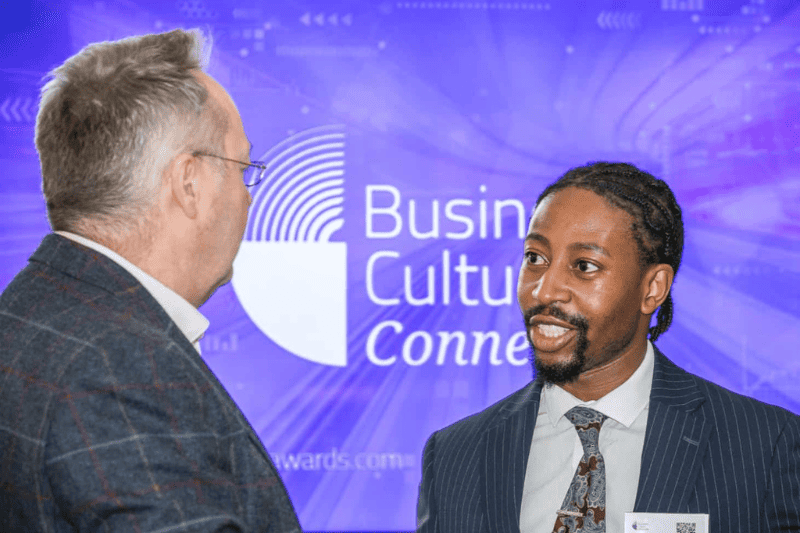
Date - Tuesday 22nd September
Venue - Squire Patton Boggs, 2nd Floor, 60 London Wall, London, EC2M 5TQ
How to get here - 60 London Wall is 5 mins walk from Moorgate, 6 mins from Liverpool Street and 8 mins from Bank Underground Stations.
Accessibility: 60 London Wall has a wheelchair-accessible entrance, the ground floor security team will be available to assist. All floors can be accessed via lifts.
Conference Agenda
8:45-9:00 Registration
9:00 - 9:15 xxx Tim Pointer, Chair of Judges
9:15 - 9:45 Keynote from current Overall Winner, xxx, Dr Carly Telford, Senior Organisational Psychologist & Helen Roberts, Business Development & Marketing Manager (Go Engage), Wrightington Wigan & Leigh NHS Foundation Trust (Overall Winner, Winner Technology & Analytics and Winner Public/Not-For-Profit 2020) Engagement, Technology
9:45-10:45 xxx, Elvin Eldic, Global Director, People & Performance Innovation (Winner Innovation) Engagement, Innovation
10:45-11:15 xxx, Helen Constantine, Talent Delivery Manager & Anthony Walker, Director, Sainsbury's + t-three (Winner Next Generation 2020) Next Generation
11:15-11:35 Coffee & Networking
11:35-12:05 xxx, Catherine Dineley, Head of Group Culture, Lloyds Banking Group - Group Culture (Winner Transformation 2020) Transformation
12:05-12:35 xxx, Eugenio Pirri, Dorchester Collection (Joint Winner Leadership 2020) Leadership, Purpose & Values
12:35-1:30 Lunch
1:30-2:00 Break out session 1 - XXX, Sheridan Orr, Chief Marketing Officer, CultureIQ TBC
2:00-2:30 xxx, Helen Kelley, Internal Communications & Engagement Director, Inmarsat (Winner Employer Brand & Values 2020) Purpose & Values
2:30-3:00 xxx, Linda Mountford, Northern Europe Commercial HR Director, John West Foods (Winner Learning 2019) Learning
3:00-3:30 xxx, Bjørn Thonvold, VP Human Resources, Xellia Pharmaceuticals (Winner International) Transformation
3:30-4:00 xxx, Sarah Elsy, Content Curation & Campaign Lead & Fiona Young, Content Director and Head of Diversity & Inclusion, Barclays + Hive Learning (Winner Learning 2020) Learning, Technology
4:00-4:30 xxx, Alexandra Pierce & Theo Keane, Domestic & General + businessfourzero (Highly Commended Team 2020)
4:30-6:00 Networking Drinks
register your interest
Book Your Tickets
Business Culture Connected is a LIVE and In-PERSON full-day event. Please select the ticket type below which is correct for your role and organisation. In-house Practitioner ticket types are not available for solution providers, vendors, coaches & consultants. All bookings will be verified.

Senior In House Practitioners
(HR & other functions)
FREE TICKET
- Free Conference tickets for Senior In-House/ Corporate Practitioners (Director-level, SVP/VP-level) working in eg. HR, Culture, Employee Experience, Transformation, DEI, Talent, Learning, or similar discipline
- Invitation-only executive breakfast and boardroom discussions
- All other Sessions: keynotes, case study presentations, panel discussions and fireside interviews.
- Lunch & refreshments throughout the day
- Conference networking, including post-conference drinks
- Access to on-demand conference content
- Free ticket registrations subject to approval
- Ticket type not relevant to solution providers, vendors, coaches & consultants
All Other In House Practitioners
(HR & other functions)
£195+VAT
- Conference tickets for all other In-House/ Corporate Practitioners (Manager-level, HRBPs and equivalent) working in eg. HR, Culture, Employee Experience, Transformation, DEI, Talent, Learning, or similar discipline
- Sessions: including keynotes, case study presentations, panel discussions and fireside interviews.
- Lunch & refreshments throughout the day
- Conference networking, including post-conference drinks
- Access to on-demand conference content
- Ticket registrations subject to approval
- Ticket type not relevant to solution providers, vendors, coaches & consultants
Non-Partnering Solution Providers / Vendors
£399+VAT
Free ticket when bringing 2 Senior In-house Practitioner guests.
LIMITED TICKETS AVAILABLE
- This is the ticket type for solution providers, coaches, consultants & other vendors who are not event sponsor or partners
- Conference networking & commercial opportunities
- Sessions: including keynotes, case study presentations, panel discussions and fireside interviews.
- This ticket type does not include entry to invitation-only boardroom discussions
- Lunch & refreshments throughout the day
- Post-conference drinks
- Access to on-demand conference content
- Sponsoring Solution Providers & Vendors receive free tickets – enquire now
Please register your details and make payment, if applicable, for the tickets you require. Please email us at [email protected], or call +44 (0)1727 847 398 with any questions.
Position your brand where your target audience are most engaged
Your workplace culture will never be a fait accompli. It is constantly evolving, and it is particular to your organisation. Business Culture Award entries capture those steps taken on your ongoing culture journey. You need to have achieved a measurable impact, but it’s the end of the chapter, not of the book.
Award Winners & Highlights 2022
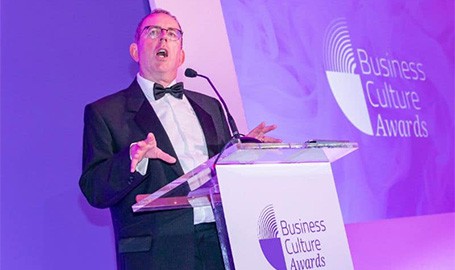
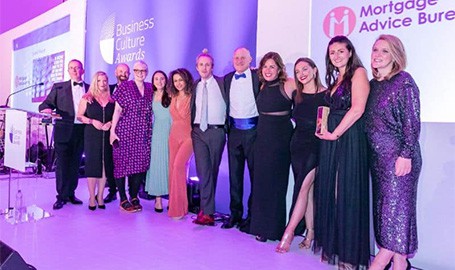
"Businesses forget about culture and ultimately they suffer for it because you can’t have good service from unhappy employees.”Tony Hsieh, Former CEO Zappos
Many Thanks to our Sponsors and Partners
 Transformation Partner
- Coaching & Mentoring Partner
- Official Media Partner
- Engagement Partner


Many Thanks to our Sponsors and Partners
- Transformation Partner
- Coaching & Mentoring Partner
- Official Media Partner
- Engagement Partner
Find out about partnership. Evolving and nurturing business culture is a leading concern of those you want to do business with. Top HR and business professionals are keen to learn more about innovative approaches to culture or to promote exceptional work. Align your own brand as one which puts culture at the forefront of business strategy.
Interested in Speaking & Sponsorship Opportunities?
To find out more, please leave your details and we'll look forward to talking to you soon to share more about this exciting opportunity!