
Organisations are facing no shortage of disruption. AI is reshaping jobs, economic uncertainty continues to test resilience, new legislative and workforce expectations are emerging, and many businesses are trying to deliver transformation while simultaneously maintaining performance. Yet one of the strongest messages to emerge from this year’s Business Culture Connected conference was that the challenge is not simply managing more change. It is building organisations capable of continually adapting to it.
The conference theme, Building a Future-Ready Culture: Practical Insights to Unlock Performance and Drive Growth, brought together practitioners, researchers, HR leaders, CEOs and culture specialists from organisations including Lloyds Banking Group, Financial Times, Alzheimer’s Society, Noble Foods, Be Caring, ECL, Recycling Lives Services and many others. Across keynotes, case studies, panels and boardroom discussions, six themes stood out.
1. Adaptability is becoming the ultimate competitive advantage
Perhaps no theme appeared more frequently throughout the day than adaptability.
Twenty-five years after the first wave of modern change management methodologies emerged, Amanda Fajak, Global Culture Practice Lead at ZRG’s Consulting Solutions, challenged delegates with a sobering observation. Organisations have more data, more models and more technology than ever before, yet resilience is falling, change fatigue is increasing and change success remains stubbornly low.
Her conclusion was simple: organisations need to stop focusing solely on managing change and instead build adaptability itself as a core organisational capability. “The competitive advantage of the next decade will be the ability to adapt, not simply superior AI or strategy,” she argued.
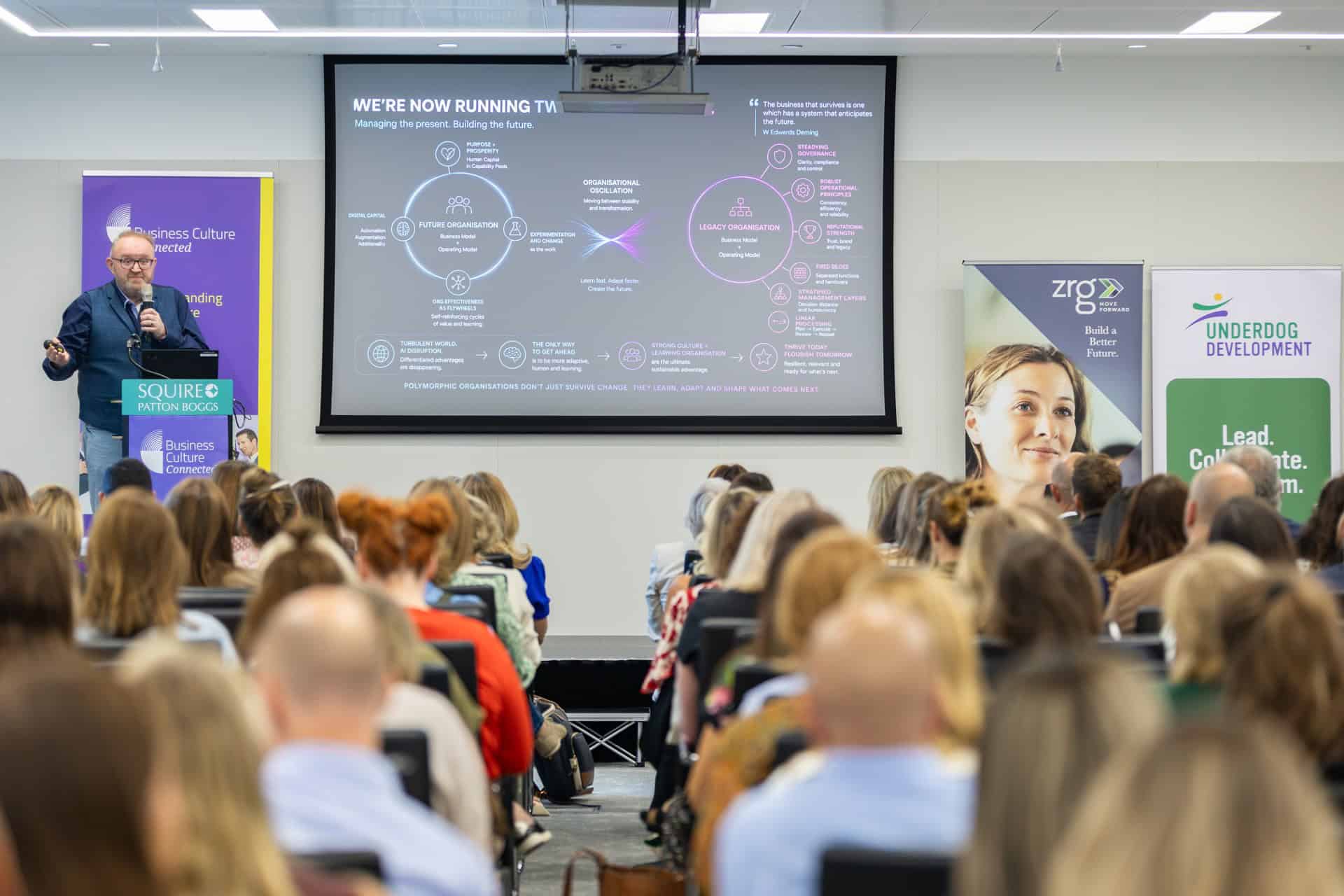
That idea was reinforced by Perry Timms, HR 3.0 Pioneer and organisational futurist, who described organisations as simultaneously running two operating systems: a legacy organisation built for the world that was, and a future organisation attempting to respond to the world that is emerging. The result is that people increasingly become the “shock absorbers” between the two.
His concept of the “polymorphic organisation” challenged traditional assumptions about fixed jobs, rigid structures and static hierarchies. Instead, organisations need what he described as “enough structure for coherence and enough fluidity for adaptation.”
Attendees repeatedly returned to this theme afterwards on social media. Adaptability, fluidity and the ability to move capability to where it can create the most value emerged as some of the day’s most shared ideas.
The discussion around adaptability also extended to AI. Matt Partovi, Head of AI Enablement & Skills and AI Transformation Lead at the Financial Times, shared how the organisation has approached AI not as a technology deployment but as an organisational transformation. Rather than starting with tools, the FT starts with work: what people are trying to achieve, which workflows matter most, and where AI can genuinely help. The organisation has invested in AI fluency, leadership capability and governance, but just as importantly has involved employees in shaping how AI is adopted. As Partovi observed, much of AI transformation turns out not to be a technology challenge at all but a people challenge. Successful adoption depends on trust, learning, experimentation and helping people understand what they will gain in return for working differently.
Tips:
• Build adaptability as a capability rather than treating change as a programme.
• Create opportunities for experimentation and learning.
• Review where capability is trapped by structures, silos or job descriptions.
• Balance consistency with flexibility.
2. Culture is not separate from performance. It is how performance happens.
A noticeable shift throughout the conference was the language people used when discussing culture.
Several boardroom participants observed that boards often disengage when culture is presented as a standalone topic. Conversations become more productive when culture is discussed through the lens of performance, decision-making, innovation, productivity and growth.
Phil Spratt, CEO and Co-Founder of Deltabase, drew our attention again to the evidence showing that positive cultures are associated with higher productivity, lower turnover and stronger shareholder returns, while disengaged employees create significant performance drag.
This was echoed by panel discussions exploring culture’s commercial value. Harsh Vekaria, Group Head of Culture Transformation, described how cultural priorities such as simplification at Lloyds Banking Group are directly linked to faster decision-making, increased responsiveness and innovation. Clémence Jacqueri, Former Head of People at IMC Trading, emphasised that long-term performance depends on consistency between mission, leadership behaviour, values and reward systems.
In the culture measurement panel, Nebel Crowhurst, Fractional Chief People Officer, suggested that culture should be viewed as an output of an aligned people strategy rather than a separate initiative. Others argued that “ways of working” may sometimes be a more useful phrase than culture because it connects more clearly with strategic delivery.
The message was clear. Culture is not an HR project. It is the collection of behaviours, decisions and interactions that either help strategy succeed or prevent it from being delivered.
Tips:
• Link culture conversations directly to business priorities.
• Frame culture through decision-making, execution and growth.
• Align people strategies to strategic objectives.
• Measure outcomes, not just activity.
3. What leaders tolerate matters more than what they communicate
One of the most powerful discussions of the day came from the ZRG boardroom session exploring the question: What are we tolerating today that is limiting our ability to grow tomorrow?
Participants discussed how small behaviours create disproportionately large consequences. Missed deadlines, unclear decision ownership, delayed feedback, ineffective meetings and inconsistent executive behaviour may seem minor in isolation. Over time, however, they establish informal standards that shape organisational culture.
Amanda Fajak and Jo Boxer at ZRG encouraged participants to think less about what leaders communicate and more about the standards they actively reinforce. The behaviours that are recognised, challenged or ignored become powerful cultural signals. Over time, organisations get more of what they tolerate and sustain what they consistently expect. High-performing cultures are built when leaders make standards visible, explicit and non-negotiable.
The same theme surfaced repeatedly elsewhere.
Jonathan Stanford, People Director at HealthTrust Europe LLP reflected on a question raised during the conference: “Who is considered untouchable in your organisation, and what is tolerating their behaviour costing your culture, performance and people?” Read featured post.
Amy Banks, Leadership & Culture Manager at Lloyds Banking Group similarly observed that high-performing organisations rarely fail because they lack values. They fail because of dissonance: “The gap between what they say matters and what actually gets rewarded.” Read featured post.
Whether discussing meeting discipline, decision-making, inclusion or accountability, speaker after speaker returned to the same conclusion: culture is ultimately created through what leaders encourage, discourage and tolerate.
Tips:
• Identify behaviours that contradict stated values.
• Deal with issues visibly and consistently.
• Make standards explicit rather than assumed.
• Focus on collective accountability, not individual exceptions.
4. The answer to overload is often focus, not more effort
Many delegates arrived feeling the same tension: organisations are asking people to deliver today’s work while simultaneously transforming for tomorrow.
As Tom Blower, Director at Underdog Leadership Development, observed in introducing the panel Building capability in an age of change fatigue, the challenge is no longer simply identifying the capabilities organisations need for the future. It is building those capabilities without adding to the overload, complexity and change fatigue people are already experiencing. During the discussion, Mark Heywood, Former Head of Performance and Recognition at NatWest Group, argued that capability building often fails because organisations treat it as an additional activity rather than creating space for it. Development only succeeds when organisations are prepared to stop doing something else first.
Louisa Hogarty, Chief People and Impact Officer at Noble Foods, described how a carefully designed leadership programme had to be fundamentally rethought after employees revealed they were overwhelmed by the volume of learning being introduced. The lesson was uncomfortable but important: even good initiatives can become part of the problem when organisations fail to differentiate between development and overload.
Corinne Mills, Deputy CEO at Alzheimer’s Society, echoed this need to create capacity before introducing more change. She described how the organisation has become far more intentional about organisational readiness, using department heads to assess what teams genuinely have the capacity to absorb and reducing unnecessary demands on leaders. Mills described HR’s role as being similar to “air traffic controllers”, deciding what can be landed safely and when. The lesson was clear: capability building is not simply about adding more development opportunities. It is also about creating the conditions in which learning, adaptation and performance can actually take hold.
Amanda Fajak argued that adaptability depends on continuous prioritisation. Organisations need the courage to decide not only what they will do, but what they will stop doing.
That message strongly resonated with attendees. Several social media reflections focused on simplification, ruthless prioritisation and stopping low-value activity to create capacity for what matters most.
As one attendee summarised afterwards: growth increasingly depends on consolidation rather than proliferation.
Tips:
Launch initiatives that promote a shift to a more adaptive culture that:
• Enable people to continuously prioritise to focus on higher value activities.
• Treat attention and capacity as a vital resource for adaptation.
• Create the conditions for learning to take hold.
5. Data is only valuable when it leads to action
If adaptability was the dominant keynote theme, action was the dominant measurement theme.
The panel chaired by Phil Spratt at Deltabase argued that most organisations do not suffer from a lack of people, culture and engagement data. Rather, they struggle to convert insight into meaningful action.
Paul Morris, Internal Communications, Culture, and Engagement Director at Standard Life captured the issue memorably when he said that employees do not experience survey fatigue; they experience “inaction fatigue.” In other words, the problem is rarely collecting feedback. It is demonstrating that something has changed because of it.
The discussion highlighted the limitations of relying solely on average scores and engagement survey results. Bushra Baig-Daykin, Associate Director of Inclusion at Alzheimer’s Society, warned that averages can often hide important realities. She argued that organisations need to look beyond headline engagement scores and pay much closer attention to the experiences of different groups within the workforce. For Bushra, meaningful culture measurement requires combining surveys with employee forums, lived-experience networks and informal listening, ensuring that quieter voices are not lost behind organisational averages.
But listening is only valuable if leaders can turn those insights into meaningful decisions. In her closing presentation, Jo Moffatt, conference chair and Strategy & Partnerships Director at Engage for Success, reinforced this with evidence from this year’s Engage for Success Employee Engagement Survey and Benchmark Index, connecting engagement to measurable productivity drivers such as collaboration, skills development, goal clarity, efficient processes and organisational integrity. Collaborative management consistently outperformed command-and-control approaches.
Taken together, the sessions highlighted an important shift in thinking. Organisations need to move beyond asking people how they feel and become much better at understanding why they feel that way, what the data is telling them and, most importantly, what action they will take as a result.
Culture, delegates were reminded, cannot be improved through measurement alone. The true test is what leaders do after they listen.
Tips:
• Connect listening directly to visible action.
• Combine quantitative and qualitative insight.
• Use multiple listening channels.
• Focus on local ownership and accountability.
• Look beyond your own organisation and use external benchmarking to understand good culture in context.
6. Future-ready cultures align purpose, people and performance
Perhaps the most inspiring moments of the day came from organisations demonstrating that purpose and performance are not competing priorities.
Be Caring shared how aligning purpose, strategy and culture has helped create an employee-owned organisation where colleague recommendation scores have risen from around 50% in 2021 to almost 93% today.
CEO Sharon Lowrie explained how the organisation’s focus on valuing care workers, providing autonomy and building a transparent culture has become fundamental to both performance and impact.
Recycling Lives Services provided another powerful example. Group CEO Adrian Murphy described a business where social impact is embedded into the commercial model itself. Through prison workshops, rehabilitation programmes and employment opportunities for people in prison and individuals rebuilding their lives after release, the organisation creates measurable social value while supporting business growth. With reoffending rates below 5% among programme participants, it demonstrated that purpose-led approaches can strengthen both societal outcomes and commercial performance.
As Tim Pointer, Operating Partner & Portfolio Chief People Officer reflected afterwards, the lesson wasn’t simply about purpose. It was about demonstrating that purpose can sit at the centre of business performance.
The examples may have been very different, but they shared the same characteristic: alignment. Values, people practices, operating models and strategic priorities were pulling in the same direction.
Tips:
• Align people practices with organisational purpose.
• Build purpose into operations rather than communications.
• Ensure values are reflected in everyday decisions.
• Use culture as a mechanism for delivering strategy, not an accompaniment to it.
The conference closed with a sense of cautious optimism. Nobody suggested there was a simple solution to the challenges organisations face. Yet there was broad agreement on one point: future-ready cultures will not be created through bigger transformation programmes or more initiatives.
They will be built through continual adaptation, deliberate prioritisation, stronger leadership accountability, meaningful employee involvement and a clearer understanding of how culture contributes to organisational performance. The same principle applies to AI. The conference repeatedly challenged organisations to treat AI as a people and culture transformation as much as a technology transformation, with employees actively involved in redesigning work rather than simply adapting to systems imposed upon them.
Or, as several attendees reflected afterwards, perhaps the task ahead is not helping people become better shock absorbers but creating organisations that ask less of them and adapt more effectively themselves.
For Case Studies & Insights on People, Culture, Leadership & Transformation, if you’re not already receiving our emails: Register to Join the Business Culture Community for Free